

Statement of the Central Committee of the Communist Party of Iran on the occasion of May 1, International Workers’ Day (2026)
2026-04-27
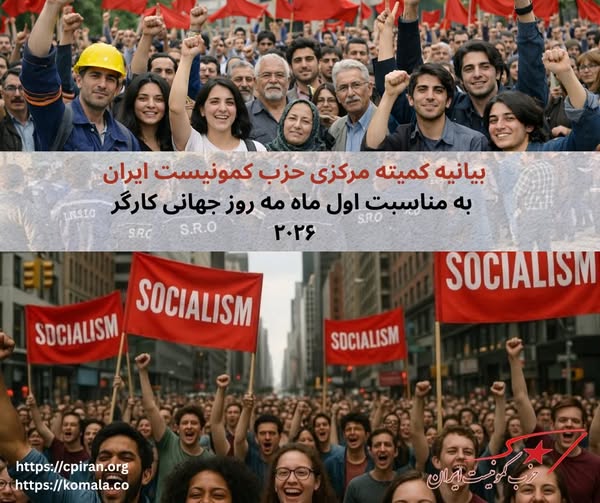
Iran’s working class approaches May 1, the symbol of workers’ international class solidarity, after a year marked by two wars. Since last May Day, it has endured a twelve-day war from June 13 to June 24, 2025, and a forty-day war from February 28 to April 8, 2026, and still faces no clear prospect for a definitive end to the conflict. The consequences of these two imperialist and reactionary wars, with the governments of the United States and Israel on one side and the Islamic Republic regime on the other, have placed the work, lives, livelihoods, security, and struggles of workers and toilers, and the majority of the Iranian people, in a far more difficult position.
The Islamic capitalist government, which had already imposed harsh conditions on the working class before these wars by setting wages far below the poverty line, cutting into workers’ household incomes, expanding contracting companies, promoting temporary contracts, destroying job security, increasing workplace casualties, and, in short, cheapening labor and intensifying repression, has used the wars and the pretext they provide to tighten pressure further on the work, lives, existence, and struggles of this class.
With the killing of thousands, mass displacement, destruction of economic and social infrastructure, internet shutdowns, unemployment for hundreds of thousands of workers, and an intensified wave of repression and executions of political prisoners, these wars have struck at the foundations of social reproduction. They have also pushed social and protest movements to the margins, disrupted their organizational development, and severely damaged the movement to overthrow the Islamic Republic. The labor movement, which before the wars had stood as Iran’s most dynamic social movement, with more than 2,000 strikes and protests each year and one of the most strike active movements in the world, has suffered a sharp decline as a result of these wars.
Radical and socialist leaders and activists in the labor movement approach International Workers’ Day while they must strengthen unity, solidarity, and mutual support in workers’ workplaces and living environments, sustain hope for change, endure the hardships of wartime, and at the same time prepare for the postwar period. Socialist activists in the labor movement, drawing on the realities of the reactionary and capitalist nature of this war, have taken a clear stance. On one side, they reject the moral collapse and inhumane positions of those who defend and praise the military attacks of U.S. and Israeli imperialism. On the other, they oppose the reactionary positions of “Axis of Resistance left” that portray the war-making of the Islamic Republic and political Islam as part of popular resistance against the domination of capital and imperialism. With a reserve of class consciousness, experience, and social credibility, they take on these difficult tasks.
Undoubtedly, the Islamic Republic, under the hegemony of the Islamic Revolutionary Guard Corps (IRCG), defined its political aim in the war as preserving and sustaining the Islamic system. It will proclaim the end of the war as a decisive victory through loud propaganda and will use this claim, with a fascistic approach, to intensify the police dominated atmosphere in society. Despite this, the consequences of wartime destruction, the deepening economic crisis, soaring inflation and prices, the erosion of energy production and transmission infrastructure, and the regime’s inability to provide bread, electricity, and water or to govern society will intensify the regime’s crisis of political legitimacy and sharpen internal conflicts within the Islamic government. On this objective basis, the labor movement and other progressive social and protest movements, after overcoming the exhaustion and strain caused by the war, will return to the field once again.
For the labor movement and other progressive social movements, what carries vital importance is a clear awareness of the need to learn from the war and from the nationwide uprisings of the past eight years, and to continue and expand the struggle against the Islamic Republic in a more conscious and organized way. This war showed how harmful and destructive it is for the Iranian people’s freedom seeking movement to rely on imperialist powers to achieve freedom, welfare, and stability. The experience of the nationwide uprisings of the past eight years, which weakened the Islamic Republic, showed at the same time that workers and the people of Iran can secure their freedom from this regime only through their own efforts. It also made clear that the Islamic government, with the structure it has, will not fall through spontaneous street protests and unorganized uprisings. Its overthrow requires organization, the formation of nationwide leadership, and a clear vision of what victory means. These experiences, like those of the twentieth and twenty first centuries, once again confirm the decisive role of the organized presence of the working class and its socialist movement in the political arena, as well as the importance of linking the factory and the street to achieve any political and social transformation.
Learning from these experiences, especially on the eve of May Day, calls on socialist leaders and activists in the labor movement to unite around a socialist strategy. This strategy must center on organizing the working class in its own political and class organizations and party, building unity and solidarity with progressive social movements such as the women’s liberation movement, the student movement, the revolutionary movement in Kurdistan, the anti-execution movement, the justice seeking movement, and others, and pursuing the overthrow of the Islamic Republic through this path. Workers have no option but to bridge the gap between their daily lives and the depth of their protest against the existing order with politics and to transform themselves into an organized political force.
Although Iranian society still lives under wartime conditions, May Day remains a well-established tradition in the Iranian labor movement. As part of their preparations for International Workers’ Day, socialist activists and advanced forces in the labor movement need to discuss the political and class necessity of uniting around a socialist strategy and making a planned effort in this direction. Without doubt, on May Day, conscious workers, alongside issuing their indictment against the unjust capitalist system and raising their immediate demands, should stress demands for freedom and equality, for women’s liberation from oppression and gender apartheid, and for the liberation of nationalities from oppression in their resolutions. By doing so, they can take a major step toward strengthening ties and solidarity with progressive social movements. On May Day, emphasizing the demand for a definitive end to the war, the release of political prisoners, and the abolition of the death penalty are demands that link the factory with other progressive social movements.
The Communist Party of Iran calls on all workers and all freedom and equality seeking people, and all those fed up with poverty and deprivation, injustice, coercion, inequality, oppression, and repression, to mark International Workers’ Day on May 1st with energy and enthusiasm in any way they can. The Communist Party of Iran honors the memory of those who lost their lives in the internationalist workers’ movement, extends May Day greetings to all workers as a symbol of vibrant class solidarity, and expresses sincere appreciation for the devoted, tireless efforts of activists and leading figures in Iran’s labor movement to organize and unite workers.
Long live May 1, international workers’ solidarity day!
Down with the Islamic Republic regime!
Long live freedom, equality, and workers’ rule!
Central Committee of the Communist Party of Iran
April 18, 2026