

Statement of the Cooperation Council of Iranian Left and Communist Forces on the Crisis of Capitalism and the Prospects for Protest Movements in Europe
2026-11-06
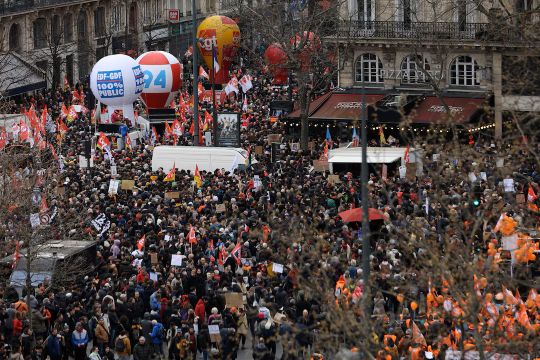
Protests in Europe: From Street Anger to the Necessity of Organizing for a Change in the Existing Power Relations
The latest protests in Europe cannot be regarded merely as a passing reaction to rising prices, declining purchasing power, or governments’ economic policies. These protests have emerged against the backdrop of the accumulated crises of European capitalism, the intensification of class inequalities, the younger generation’s growing sense of having no future, the expansion of militarism, and the erosion of trust in the ruling political parties and institutions.
What is manifested in the streets is not simply dissatisfaction with existing conditions; it is a clearer sign of the widening gap between the interests of the majority of society and the economic and political priorities of the ruling class.
Therefore, the decisive question is not merely the scale of these protests or the number of people taking to the streets. The question is whether these protests can move beyond their current stage and develop into an independent, organized, and sustained force capable of transforming the existing relations of power.
Economic Crisis, War, and the Assault on People’s Livelihoods
The European economy was still grappling with the consequences of the 2008 global financial crisis when the COVID-19 pandemic triggered a recession and widespread disruption to economic activity. This was followed by the war in Ukraine in February 2022, which, together with the energy crisis and rising prices of essential goods, placed additional pressure on the lives of millions of workers, wage earners, pensioners, and other working-class and disadvantaged sections of society.
The reduced access to Russian energy resources, particularly for Germany’s industrial economy, was one of the factors driving up production and energy costs. Inflation and declining purchasing power, combined with pressure on real wages and social services, further deteriorated living conditions for broad sections of the population.
Meanwhile, European governments allocated enormous resources to military support, arms purchases, and increased defence spending, while falsely claiming that they lacked sufficient funds for education, healthcare, wage increases, public services, and pension entitlements.
Subsequently, military tensions and conflicts in the Middle East, including the reactionary war involving Israel, the United States, and the Islamic Republic of Iran, have further heightened the risk of an escalating energy crisis, bringing yet another increase in the cost of living.
Ultimately, it has been workers and low-income sections of society who have suffered most from declining purchasing power and growing economic insecurity. The fundamental contradiction, however, lies in the fact that social wealth—the product of the labour of millions of people—is being spent not on ensuring public welfare and meeting people’s needs, but rather in accordance with the priorities of capitalism and military and geopolitical rivalries.
The Crisis of Ruling Parties and the Limitations of Parliamentary Politics
One of the defining features of current social and class-based protests is the growing scepticism towards the ability of conventional political mechanisms to address people’s demands.
Across various European countries, conservative, liberal, and social-democratic parties have alternated in power. Despite their political and programmatic differences, a significant part of their economic policies has continued to operate within the framework of preserving capitalist relations and the existing structures of power. Consequently, for the majority of society, changes of government and the replacement of political parties through elections no longer signify any fundamental improvement in their living conditions.
The presence of people in the streets, strikes, and various forms of direct protest must be understood within this context. These protests demonstrate that social and class-based demands cannot always be confined to electoral competition and the promises of ruling parties.
The streets can challenge the legitimacy of established policies, but they cannot, on their own, transform existing relations of power. This is one of the fundamental challenges facing Europe’s current protest movements. Transforming the existing relations of power requires the development of political party structures, a political programme, and the necessary institutions.
The Far Right and the Diversion of Social Discontent
Amid the economic crisis and declining confidence in traditional political parties, far-right movements are seeking to turn social discontent into a force serving their own political objectives. Instead of criticising unequal economic relations and existing power structures, they portray immigrants, refugees, and Muslims as the causes of social crises.
In this discourse, the contradiction between labour and capital is falsely replaced by an antagonism between the native population and immigrants. This shift represents a deliberate and fundamental political and ideological manoeuvre by right-wing and far-right forces. It divides workers and working people, who share common interests in defending wages, social services, and economic security, by setting them against one another on the basis of nationality, religion, and cultural background.
In sections of Europe’s far right, anti-immigrant sentiment and Islamophobia have become central elements of political mobilisation. At the same time, some right-wing movements that were historically associated with anti-Semitic traditions have combined support for Israel with anti-Islamic rhetoric and the defence of Western civilisation. Some conservative and social-democratic parties, too, have aligned themselves with the right’s anti-immigrant positions in electoral competition rather than confronting this discourse.
The positions adopted by monarchists and fascists who support Reza Pahlavi, as well as their growing alignment with the right-wing policies of the United States and Europe, must also be examined within this framework. Monarchists who align themselves with warmongering, anti-immigrant policies, or hostility towards social movements are, in practice, acting against the common interests of workers and working people, including Iranian immigrants.
By transforming class discontent into national, religious, and cultural hostility, the far right undermines the possibility of building social solidarity and diverts attention away from the actual structures of power. Confronting this trend is an inseparable part of the struggle for social equality and the independent organisation of workers and working people.
Street Protests and the Question of Social and Class Power
Mass protests can force governments to retreat, change specific policies, or compel them to meet immediate demands. These achievements are important and should not be overlooked. However, there is a fundamental difference between forcing a government to make concessions and transforming the relations upon which economic and political power is organised.
Street protests, particularly when they are widespread and driven by strong collective determination, can plunge the existing political order into a crisis of legitimacy. Nevertheless, if this social force cannot organise itself through independent organisations and institutions, it faces the risk of exhaustion, fragmentation, and absorption into existing political mechanisms. Under such circumstances, ruling parties can contain part of the social pressure through limited concessions, changes in the composition of governments, or promises of reform, without fundamentally transforming existing relations of power.
The widespread and determined protests of today demonstrate the capacity to say no to the existing state of affairs. However, lasting change requires a force capable of putting forward an independent vision and programme for how society should be governed, how power should be organised, and how it should be held accountable. Therefore, the central question is how to transform the energy of protest into independent organisation, political consciousness, and autonomous social and class power.
The Labour Movement: The Decisive Link in the Transition from Protest to Power
The labour movement occupies a decisive position in this process. The power of workers lies not merely in their numbers or their presence in the streets, but in their position within production, services, and the economic life of society.
When street protests are linked to strikes and organisation in workplaces, their capacity to influence existing relations of power increases. The political and moral support that trade unions provide to protests is important, but it is not enough. Such support must be translated into organised strikes and lasting links between workplaces and street movements.
An example of this was the refusal of workers at approximately 130 ports around the world to load weapons and military equipment destined for Israel. The ability of workers to maintain their organisational independence, expand democratic participation, and connect immediate demands with broader social, class-based, and political objectives is a central issue for the labour movement. Independent workers’ organisation can transform scattered protests into a sustained struggle backed by broad social power.
From Immediate Demands to a Socialist Alternative
Defending higher wages, pensioners’ rights, public services, job security, and opposing austerity policies are essential components of social and class struggles. However, even the achievement of these necessary demands does not, in itself, bring an end to the relations that reproduce inequality and economic crises. This makes the connection between immediate struggles and the prospect of fundamental change particularly important. Such a connection is not established by disregarding people’s everyday demands, but rather through the expansion of independent organisation and their conscious participation. Independent workers’ organisations, democratic institutions, networks of social solidarity, and political organisations with a clear programme for transforming economic and social relations can lay the foundations for turning the power of protest into a sustainable force.
From our perspective, the ultimate goal cannot be limited to replacing political parties within the existing system or managing the same economic relations differently. The issue is to transform relations in which decisions concerning production, the distribution of wealth, and social resources are largely governed by the logic of profit and the power of capital. This requires the emergence of a socialist movement in Europe capable of clearing away the debris left by the collapse of the Soviet bloc, opening the way for the rise of a broad and radical labour movement, and, through this process, putting forward clear solutions for securing freedom, equality, public welfare, and social control over economic resources. Without this strategic orientation, protests risk being drawn back into the framework of existing policies. And without a clear political vision, organisation itself may be reduced to a limited defence of past achievements.
International Solidarity and the Future of Protest Movements
The crisis of capitalism, militarism, social inequality, and the rise of the far right are phenomena that are not confined by national borders. Confronting them therefore requires expanding solidarity among workers and social movements across different countries. Workers and working people throughout Europe, regardless of nationality, religion, or cultural background, share common interests in defending wages, social services, democratic freedoms, and opposing war. Socialist forces, labour activists, and advocates of equality, including Iranian activists living in Europe, can play an effective role in strengthening this solidarity, confronting anti-immigrant sentiment, and advancing independent organisation.
The future of Europe’s protest movements is not predetermined. These movements may lead to limited government concessions, electoral changes, or temporary reforms. However, the possibility of going beyond these limitations also exists. Realising this possibility depends on the ability to build a socialist movement suited to the global conditions of the post-war era, the capacity of social movements to establish independent organisations, the linking of street struggles with the labour movement, and the development of a political vision for transforming existing relations of power.
Concluding Remarks: The Streets Are the Beginning, Not the End
Protests across Europe once again demonstrate that social discontent can develop into a broad and visible force challenging the policies of those in power. However, the scale of protests alone does not guarantee lasting change. The prevailing political and economic power cannot be dismantled simply through the presence of protesters in the streets. Power relations are deeply rooted in institutions, economic structures, political apparatuses, and organised networks of class interests. Transforming these relations requires political party organisation, independent workers’ organisations, a political programme, sustained struggle, and the establishment of independent social and political institutions.
In addition to emphasising the need to defend the livelihoods and social and political rights of workers and working people, the Cooperation Council of Iranian Left and Communist Forces stresses the importance of opposing austerity and warmongering policies, fighting anti-immigrant sentiment and the far right, and expanding international solidarity.
Beyond these demands, the Council also insists on a fundamental necessity: for social protests to lead to lasting change, they must move beyond the mere expression of discontent and develop into an independent, conscious, and organised force. A force capable not only of resisting the policies of those in power, but also of proposing and realising an alternative vision for organising the economy, society, and political relations.
The streets can be the starting point of change; however, the fate of that change will be determined by people’s ability to organise independently and transform the power of protest into a lasting social force. The future belongs to a struggle capable of transforming social anger into political consciousness, consciousness into organisation, and organisation into a force for freedom, equality, and emancipation from the domination of capital.
Long Live Workers’ International Solidarity!
Long Live Freedom! Long Live Socialism!
Cooperation Council of Iranian Left and Communist Forces
November 2, 2026
Signatories: Workers’ Socialist Union; Communist Party of Iran; Worker-Communist Party of Iran–Hekmatist; Raah-e Kargar (Workers’ Way) Organization; Organization of the Fadaiyan (Minority); and Minority Faction Core.