

Statement by the Cooperation Council of Iranian Left and Communist Forces on the Wave of Protests Against Social and Class Inequality in Europe
2026-10-21
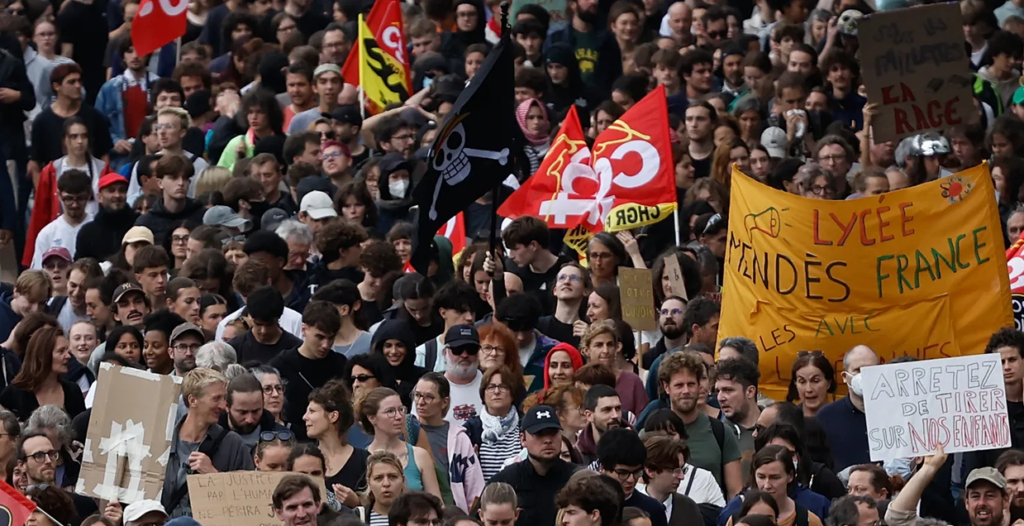
For several weeks now, European cities have been shaking under the feet of protesters taking to the streets. Young people from poor families, workers, and laborers are the driving force behind this mass uprising.
This latest wave of nationwide protests initially began at a school in the poor northern suburbs of Paris. On Saturday, September 21, students at Paul Éluard High School staged a demonstration and shut down the school to protest the extremely poor sanitary and physical conditions of the building—including the presence of rats and cockroaches, water outages in the school toilets, and unsuitable classroom temperatures—as well as a severe shortage of teachers and educational staff. What began as a spark quickly escalated into a nationwide crisis and movement across France.
Following the students, university students, trade unions, pensioners, the Yellow Vests, and broad sections of the working class took to the streets in various cities across France. On Saturday, October 17, more than 800,000 people participated in this series of protests. According to the police, around 2,000 people were arrested, and many others were injured. In Paris, at least one protester died following cardiac arrest. Although this nationwide uprising largely took the form of marches, chants, and the singing of protest songs, police violence led, in some cases, to street clashes and running battles, as well as the looting and burning of shops, stores, and vehicles.
Similar demonstrations and protests have also taken place in several other European countries, including Spain, Portugal, Italy, and Albania. In Lisbon, the capital of Portugal, protesters have also set up a camp where a round-the-clock sit-in is continuing.
In Albania, students took to the streets to protest poor university conditions and high tuition fees. The protests quickly spread to broad sections of the population, particularly in Tirana. Last year, these same people also staged widespread protests as part of the “Flamingo Movement,” opposing a tourism development project. Under a corrupt deal, the Albanian government intended to grant the Trump family, including Trump’s son-in-law Jared Kushner, a license for a multi-billion-dollar tourism project along the Albanian coast.
This movement stems from the structural crisis of the capitalist system and the struggle against the austerity policies of capitalist states. A common thread linking many of the protests in European cities—and even in other parts of the world, such as the massive demonstrations by trade unions and the people of Tunisia on Saturday, as well as the widespread movement known as “Cockroach” in India, which has become a symbol of the younger generation’s resistance to problems in education, unemployment, corruption, and electoral fraud—is one thing: opposition to the rapid growth of social and class inequalities, the cost-of-living crisis, and the collapse of purchasing power among the vast majority of the working and toiling masses.
The housing and rent crisis in major cities, stagnant wages and salaries, inflation, and soaring prices of goods—which have reached a peak amid the energy crisis triggered by the war involving the United States, Israel, and Iran—as well as the repercussions of the war in Ukraine and other factors, have made it impossible for the vast majority of impoverished people in both urban and rural areas to lead a normal and dignified life.
Under these conditions, capitalist governments, while increasing spending on security, policing, and the military and insisting on not raising taxes on capitalists and billionaires, see no easier way to make up budget deficits than to cut public and social spending on healthcare, education, housing, and benefits for the elderly, pensioners, and the unemployed—and, of course, to freeze workers’ wages.
In the United States, although widespread nationwide street protests have not yet emerged, public dissatisfaction with the economic, political, social, and military policies of the Trump administration is growing day by day.
Over the course of the seven-month-long reactionary and devastating war between the United States and Iran, in addition to the deepening economic hardship in our country, the American people have also paid more than $100 billion in additional costs for gasoline and diesel fuel. This, in turn, inevitably affects the prices of other goods and services.
Meanwhile, during the same period, two major American oil companies—ExxonMobil and Chevron—have recorded more than $40 billion in net profits, while U.S. banks have reported over $175 billion in net profits. Three arms manufacturers, in addition to earning tens of billions of dollars in profits, have also received approximately $900 billion in new orders.
This global crisis—the rapid deterioration of the living standards and livelihoods of workers and working people—is a direct consequence of the capitalist system, which has widened the class divide between the lowest and highest income deciles of society to astronomical proportions, with each passing day.
In its relentless pursuit of greater profits, this system has intensified the exploitation of human beings while driving nature and the planet toward destruction and gradual extinction. The continuous waging of wars, devastation, and mass killings—driven by the needs of imperialist corporations, particularly those in the military-industrial sector—has further exacerbated the economic and humanitarian crises across the world.
These crises and inequalities once again affirm the validity of our radical critique, as revolutionary socialists, of the capitalist system—a hellish system that has left humanity burdened with approximately one billion hungry people and more than 130 million refugees and displaced persons.
Therefore, socialist and radical forces must actively participate in the ongoing popular movements and uprisings while putting before workers and working people the necessity of moving beyond capitalism, rather than merely seeking to reform it or force it into isolated concessions and retreats.
Meanwhile, it is important to recognize that amid the deepening social and economic crises, it is not only socialist and anti-capitalist discourse that is gaining greater traction. Neo-fascist movements are also seeking to promote and spread their own inhumane alternative by misleading the deprived masses. Rather than pointing to the class-based and systemic roots of these crises within capitalism, they direct attention toward peripheral factors, such as particular government policies or the so-called “threat posed by immigrants and national and religious minorities.” In doing so, they seek to divert the attention of workers and their children away from the fundamental source of corruption, crisis, and inequality: the capitalist system.
The Cooperation Council of Iranian Left and Communist Forces firmly supports the struggles, demands, and uprisings of the working and toiling masses against the capitalist system and anti-popular governments. We call on all activists of the Council to actively participate in the ongoing mass protests in the cities where they live.
Long live workers’ international solidarity!
Long live freedom! Long live socialism!
Cooperation Council of Iranian Left and Communist Forces
October 20, 2026
Signatories: Workers’ Socialist Union; Communist Party of Iran; Worker-Communist Party of Iran–Hekmatist; Raah-e Kargar (Workers’ Way) Organization; Organization of the Fadaiyan (Minority); and Minority Faction Core.
international@cpiran.org