

Interview by “Kaldıraç magazine”, Kaldıraç Movement’s revolutionary socialist monthly with a group of Iranian labor activists
2025-11-09
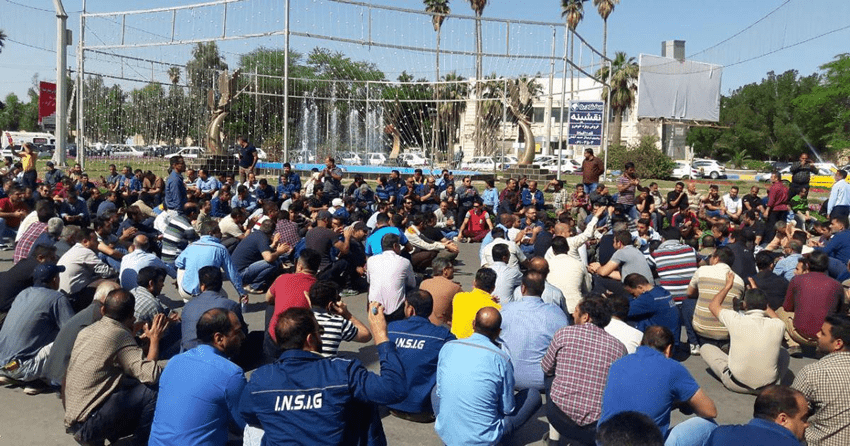
“The regime fears large-scale, nationwide workers’ strikes more than anything else.”
In this interview with a group of Iranian labor activists, we discussed the current state of the workers’ movement in the country, the role of trade unions and their connection and solidarity with the broader class struggle in the region. The activists reflected on the development of class consciousness among workers through their own experiences, assessed how U.S.–Israeli attacks have been perceived by workers and society and evaluated the domestic political repercussions of these assaults. They also emphasized the importance of the financial independence of labor movements and shared their differing views on several parties and movements, including a party from Iran with which we had previously conducted an interview. While these evaluations belong to the activists themselves, the interview provided us with an important framework for understanding the internal debates within the workers’ movement in Iran.
Here is our interview:
1. What is the current status of the worker’s movement and the frequency of workers’ activity? What kinds of actions and demands are most common and prominent?
For about a decade, workers in Iran have held roughly two thousand labor strikes each year. These strikes have taken place in large and medium-sized factories and industrial complexes, while little is known about small workshops. Due to heavy censorship and a lack of free information, the number of workers participating in these two thousand annual strikes remains unclear. Most demands are economic, and most strikes focus on higher wages, payment of overdue wages, cancellation of temporary contracts, and improved working conditions.
Given the large-scale street movements against the government over the past decade, the balance of power has shifted somewhat in favor of workers. However, security forces still arrest labor activists and fire them from their jobs for their activities, and repression remains the main obstacle to the labor movement’s progress.
Anti-capitalist and especially anti-government sentiment runs deep among workers. During some strikes, they hold rallies and chant slogans against employers or certain government officials and institutions.
Despite costly and intensive religious propaganda targeting workers and the public, religion has lost influence among workers compared to the past. Some workers are not religious at all, others lack strong religious beliefs, and only a small minority still hold firm faith. The leading and organized sections of workers are mostly radical leftists. Right-wing tendencies in Iran’s labor movement are very weak and marginalized, though struggles against reformism within the movement continue.
Over the past decade, workers’ living conditions have sharply deteriorated, and their incomes have fallen well below the poverty line several times. Inflation and unemployment remain severe, and one major obstacle to labor activism is the fear of losing jobs and falling into extreme poverty.
2. Can you describe the current status of workers’ organizations and labor unions? How do official unions function in relation to the regime, and how widely can the independent unions organize?
In Iran, there are virtually no independent, official, or legal labor unions or associations, and the regime does not recognize them. After the severe repression and widespread massacres of the 1980s, when many labor activists and communists were killed, imprisoned, or forced into exile, workers’ struggles fell into deep stagnation, and nearly all labor organizations disappeared. However, in the 1990s, strikes and protests began again, initially against privatization and layoffs, and later expanded to other issues. Alongside these struggles, efforts to form labor organizations also emerged.
Two main perspectives developed: one leftist and one conservative or right-leaning. The left believed that even without legal recognition from the regime, labor organizations could still form and survive with workers’ support. The conservative view argued that such efforts would fail and that activists should instead seek legal recognition or operate within official government institutions. Eventually, the left gained the upper hand, and parts of the workforce became organized. The Syndicate of Tehran Bus Drivers and the Haft Tappeh Sugarcane Workers’ Syndicate were established. Labor activists from various workplaces also created groups such as the Coordinating Committee to Help Form Workers’ Organizations, the Follow-up Committee to Form a Workers’ Organization, and the Free Union of Iranian Workers.
Two other major organizations formed that can also be considered part of the working class. Teachers succeeded in creating professional associations and elected a council to lead them. In practice, this council functions as a national teachers’ union, representing thousands of members who have organized many strikes, gatherings, and protests.
Another notable group is the retirees’ association, composed mainly of retired workers. Each year they hold numerous rallies and have established professional associations that function as unions or syndicates. Every year, they organize dozens of street protests demanding higher pensions and expressing solidarity with other workers. In fact, retirees in Iran rank among the most active, organized, and militant in the world.
Another form of labor organization in Iran is the secret workers’ committees found in workplaces. As repression of the labor movement has intensified, many workers have turned to forming underground groups to coordinate strikes and protests. Some have grown strong and led large strikes, such as the Council for Organizing Protests of Contract Oil Workers, which operates covertly, along with many unnamed committees active in workplaces.
In practice, the Iranian labor movement combines both underground and open activity. Depending on workplace conditions and the balance of power, workers choose different approaches to secrecy or openness. The debate over how to balance these two forms has always existed and at times caused disagreements among labor activists.
The organized segment of the workforce remains small compared to the overall working class, mainly because of repression and the ban on labor organizations. Yet even this limited organization has significantly influenced the progress of the labor movement. The strategy of building labor organizations through workers’ own initiative remains a core objective of activists and continues despite all obstacles.
3. How does the regime use the official unions to hinder workers’ actions and maintain its rule? Are there espionage activities by unions towards workers, how do they manage workers’ discontent?
In Iran, several state-controlled labor organizations exist—the Workers’ House and the Islamic Labor Councils. However, these bodies lost credibility among workers long ago, and labor and socialist activists have strongly exposed their true nature. Their members are government agents, yet these organizations still serve several purposes for the regime.
First, under the labor law’s annual wage determination system, a tripartite mechanism operates, involving representatives of employers, workers, and the government. At the end of each solar year (Iranian calendar), they meet to set the minimum wage for the coming year based on inflation. In this system, the government itself is a major employer, and the so-called worker representatives come from these state-controlled organizations. In effect, the system is completely biased toward capitalists and holds no legitimacy for workers.
Second, these government-backed “worker representatives” attend the International Labour Organization’s annual meetings as delegates of Iranian workers, promoting the regime’s agenda.
Third, they organize official May Day ceremonies each year with state funding and support, trying to keep workers under their influence.
Fourth, they secretly cooperate with government security agents to identify and target labor activists.
Another tactic the regime uses against independent labor organizations is infiltration or the creation of parallel groups. There are several examples of this. By infiltrating and sowing division within the Haft Tappeh Sugarcane Workers’ Syndicate, the authorities managed to significantly weaken it. They attempted the same with the Tehran Bus Drivers’ Syndicate, but because of the group’s strong unity and the leaders’ awareness, the regime’s plan failed.
As noted, the regime’s puppet organizations have no social base among workers, yet they still harm the labor movement in various ways.
4. How do you assess the levels of class consciousness among the workers? How much do the demands for regime change intersect or coexist with socialist, revolutionary, anti-capitalist demands?
Almost all existing labor organizations in Iran, except the teachers’ union, follow a leftist orientation. The teachers’ organization includes leftist, centrist, and right-leaning tendencies.
Most labor activists envision forming nationwide workers’ councils once a revolutionary situation emerges and authoritarian rule retreats. The idea of establishing such councils under favorable conditions enjoys strong support among labor activists in Iran. In other words, the council-based approach has many advocates among labor and leftist activists, and most of them see a council government as their preferred alternative.
The tens of millions who make up Iran’s working class remain largely unorganized. This reality stems not from workers’ ignorance but from harsh repression and dictatorship. About forty-six years ago, after the revolution that overthrew the monarchy, the labor movement was far less advanced than it is today. Yet the brief period of relative freedom at that time allowed the creation of thousands of councils, unions, and syndicates. Today, workers’ awareness and understanding of the need for organization have grown much deeper than before.
In Iran, many segments of the bourgeoisie belong to the opposition—liberal groups, monarchists, and even reformists who once served the regime but now try to present themselves as opposition figures. As the labor movement grew, with more strikes and the formation of several labor organizations, these forces sought various ways to gain influence among workers and activists.
Since 2005, the Solidarity Center, a U.S.-funded organization, has attempted to approach independent labor groups by offering financial aid. This move sparked extensive debates within the Iranian labor movement over the issue of financial assistance. Eventually, thanks to Marxist critics and labor activists, financial independence became an accepted principle among most organizations and activists, marking a major victory for the Iranian labor movement. However, some groups and individuals still reject this principle. For instance, the Worker-Communist Party of Iran, which has limited influence in the labor movement, does not believe in the financial independence of the working class. It has frequently held joint actions with monarchists abroad and refuses to cooperate with other leftist or communist forces.
Liberal, monarchist, and reformist groups have also made persistent efforts to infiltrate the labor movement. Yet, because of the exposure and resistance led by communist parties, organizations, and many conscious labor activists, these groups have failed to gain ground and remain very weak within the movement. Nevertheless, reformist and right-wing elements still exist and continue to pose risks to the labor struggle.
Awareness and ignorance are relative concepts, and in this sense, the Iranian labor movement possesses a degree of consciousness in the ways described above. Workers who have organized or understood the need for collective struggle even under dictatorship demonstrate a certain level of awareness. The commitment to financial independence among activists and organizations, their relative separation from right-wing movements, and their inclination toward council-based structures all reflect notable class consciousness.
Most Iranian workers have either moved away from religion or show far less religious devotion than before.
At the same time, tens of millions of workers still remain unorganized due to intense repression. Like most people in Iran, workers despise the Islamic Republic and want to see it overthrown, but they lack a clear alternative to replace it. As mentioned, organized activists in the labor movement tend to lean left, yet the broader working masses have no defined political alternative of their own and are often influenced by right-wing opposition media.
In reality, no political force—left or right—has achieved hegemony within the working class, just as none dominates Iranian society as a whole. The struggle between competing alternatives continues within the working class. Still, the organized segments, which are likely to grow, already display a significant level of political and class awareness.
NOTE: QUESTIONS 5 and 6 are merged and answer to both is given together.
5. To what extent does the working class struggle in Iran assess its strategy and fate to coincide with the struggles of working classes in the region as a whole? How much do they think they face the same problems arising from the same causes, most particularly regarding the capitalist-imperialist rule in the region?
6.What kind of changes, if any, did the recent attacks and threats by US-Israel cause among the working class regarding their attitudes and opinions towards the regime?
Due to the uneven development of capitalism in the Middle East and the vastly different conditions of the working class across the region, as well as the absence of a socialist or labor-oriented alternative, connections and exchanges between labor activists in Iran and workers in neighboring countries remain limited. However, Iranian labor activists have consistently shown solidarity with Afghan migrant workers in Iran, especially on occasions such as May Day, and have demanded equal rights for them.
Regarding the issue of Palestine and Israel, labor and socialist activists have generally emphasized the Palestinians’ right to self-determination. Yet within the broader working class, the level of solidarity with the Palestinian movement has been low, partly because the Islamic Republic has long supported and funded reactionary groups such as Hamas and Hezbollah. Thus we sometimes hear slogans like “Forget Palestine, think about us” or “No to Gaza, no to Lebanon, my life for Iran.” However, after the Gaza war and Israel’s large-scale atrocities, these negative attitudes toward Palestinians have largely faded. Most workers now distinguish between the Palestinian people and groups like Hamas or the Iranian regime.
During the twelve-day war and the U.S.–Israeli attacks, monarchist groups expected workers and the public to rise up against the regime and side with the aggressors. Yet the working masses and ordinary people refused to align themselves with those who sought regime change through military intervention. At the same time, their view of the Islamic Republic did not change during the attacks. Workers still see the regime as their main enemy.
Almost all independent labor and popular organizations issued statements condemning both sides of the conflict—the U.S. and Israel on one hand, and the Islamic Republic on the other—while taking a clear anti-war stance. The majority of workers and citizens reject participation in any war on behalf of the Islamic Republic. They see the conflict as one between capitalist regimes, not between peoples. Most labor and Marxist activists define the struggle against imperialism as part of the broader struggle against capitalism, considering the two inseparable.
7.And what kind of changes, if any, did the recent attacks and threats by US-Israel cause within the ruling classes, Mollas and government regarding their attitudes and opinions towards the people? There appears to be new developments regarding the laws on mandatory hijab. How do you assess these developments and are there similar moves by the regime?
Immediately after the twelve-day war, the regime and its security apparatus arrested around two thousand people, including several labor activists. The government is fully aware of the workers’ and public’s potential for protest and discontent, and it seeks to exploit the wartime atmosphere to intensify repression. Labor activities have become more restricted and difficult. The regime fears large-scale, nationwide workers’ strikes more than anything else.
Regarding compulsory hijab, after the mass uprising of 2022 under the slogan of “Woman, Life, Freedom” and codenamed “Zhina movement”, the regime partially retreated, and some women now appear in public without mandatory headscarves.
The economic situation worsens daily, creating strong potential for widespread protests and strikes. The regime focuses primarily on suppressing these movements rather than on possible future attacks by the U.S. or Israel. Over several decades of repression, the Islamic Republic has built a force of hundreds of thousands of trained and well-equipped security agents, always ready to confront labor and popular movements. The balance of power has not yet shifted significantly in favor of the workers.
8. What kind of regional solidarity do you see as possible among the working class in the region?
An organization that brings together worker representatives from various countries in the region—where they can exchange ideas, issue joint statements and declarations, and adopt a shared anti-capitalist stance—could strengthen the labor movement across the region and foster unity and solidarity among workers. Communication remains very limited, and workers are largely unaware of each other’s struggles and activities in neighboring countries. A regional organization is needed with an explicitly anti-capitalist platform, operating openly and with a clear identity.
Such an organization could also establish a workers’ solidarity fund to support striking workers or those dismissed for labor activism.
Even if labor organizations across the region simply coordinate and take common positions against wars and the repression of workers, it would still be valuable, promoting mutual support and regional labor solidarity.
A group of Iranian labor activists
October 2025